Induction Cookware Sets
A new induction hob requires cookware specifically designed for it. Not every pan works on induction, and the wrong base can result in a hob that doesn't respond or heats unevenly. In the induction cookware sets collection, you'll find complete sets from Culicartel that are guaranteed to work on your induction hob, from entry-level sets for everyday cooking to professional stainless steel sets from brands such as Demeyere, DUCQ and Zwilling. This way, you can get everything you need at once without having to search separately for suitable pans. Not sure what's right for you? Read on for our independent buying advice or browse our complete cookware set collection.
Filter

Zwilling TrueFlow 5-piece Cookware Set
4.7 (60 reviews)
155,-
279,00

Zwilling Passion 5-piece cookware set
4.7 (23 reviews)
159,-
299,00

Demeyere 5-piece Pan Set 'Diverto 3'
4.6 (10 reviews)
249,-
409,00

Demeyere 5-piece 'Lino 3' Pan Set
4.7 (14 reviews)
279,-
419,00

Greenpan 10-piece 'Padova Reserve Black' Cookware Set
4.9 (14 reviews)
289,-
399,90

Zwilling 'Vitality' 5-piece Cookware Set
4.0 (4 reviews)
163,-
299,00

DUCQ Cookware Set 4-piece Downdraft 3-ply
4.8 (5 reviews)
319,20
399,00

Greenpan 10-Piece Cookware Set 'Padova Cream White'
4.2 (6 reviews)
289,-
399,00

DUCQ 6-piece Pan Set Downdraft
4.8 (5 reviews)
539,-
679,00
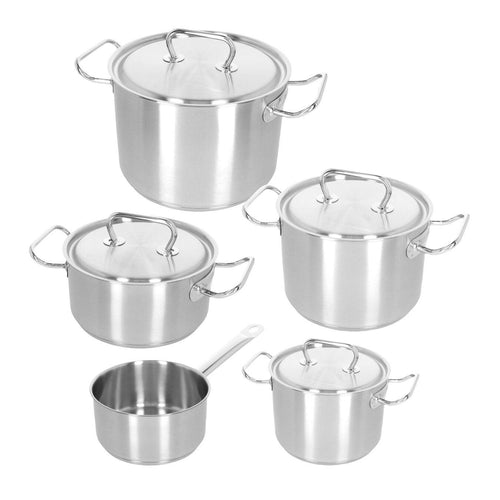
Demeyere 'Classic 3' 5-piece Cookware Set
239,-
319,00

DUCQ Copper Pan Set 6-piece
5.0 (3 reviews)
625,-
799,00

Zwilling 'Simplify' 5-piece Cookware Set
5.0 (5 reviews)
217,-
349,00

Greenpan Cookware Set 10-piece 'Padova Oxford Blue'
5.0 (1 review)
289,-
399,00

Demeyere 'Classic Pro 3' 5-piece Cookware Set
4.6 (7 reviews)
199,-
359,00

Zwilling Essence 5-piece cookware set
4.0 (1 review)
169,-
299,00

KitchenAid 7-Piece Tri-Ply Stainless Steel Cookware Set
5.0 (1 review)
309,90
449,90

Greenpan 10-piece Cookware Set 'Padova Blush Pink'
289,-
399,90

Greenpan 10-piece 'Padova Mint Green' Cookware Set
3.7 (3 reviews)
289,-
399,00

Greenpan 10-piece Cookware Set 'Padova Skyblue'
299,-
399,90

DUCQ Copper Pan Set 4-Piece
5.0 (2 reviews)
375,20
469,00

Demeyere 5-piece 'Comfort 3' Cookware Set
5.0 (3 reviews)
229,-
289,00

DUCQ Copper Cookware Set 3-piece
319,20
399,00

Greenpan 10-piece 'Padova Light Blue' Cookware Set
4.0 (2 reviews)
289,-
399,90

Demeyere 3-piece 'Silver 7' Cookware Set
4.0 (1 review)
579,-
725,00

DUCQ Copper Cookware Set Small 6-piece
580,-
725,00

Demeyere 3-Piece Cookware Set 'Intense 5'
499,-
705,00

BK 4-piece Pan Set 'Twist'
195,-
299,90

BK 4-Piece Pan Set 'Flow Cool Black'
2.0 (1 review)
179,-
259,90

Greenpan 3-piece Cookware Set 'Geneva'
169,90
234,90

BK 4-piece 'Profiline' Pan Set
5.0 (1 review)
135,-
179,90
Frequently asked questions
-
What makes a cookware set suitable for induction?
-
How do I check if my pans are suitable for induction?
-
Do all pans work on induction?
-
Why does my pan hum or vibrate on the induction hob?
-
Does the pan have to be the same size as the cooking zone?
-
What is the difference between a stainless steel and a ceramic cookware set for induction?
-
Are PFAS-free cookware sets just as suitable for induction?
-
How many pans do I need in an induction cookware set?
-
Are your cast iron pans suitable for induction?
-
Which brand of cookware set is best for induction?